Showing posts with label science. Show all posts

Friday, September 23, 2016

SSU participates in cyber security research

SAVANNAH – Savannah State University’s (SSU) Qian Chen, Ph.D., assistant professor of computer science technology, and two students completed a summer research project aimed at protecting infrastructure. Chen was joined by Summer Sykes, a senior electronics engineering technology student from Atlanta, Ga., and Chelsea Calhoun, a senior in computer science technology from Jacksonville, Fla.


(L-R) Jeff Nichols, Ph.D., SSU student Summer Sykes, SSU student Chelsea Calhoun, Qian Chen, Ph.D., and PhD candidate Jarilyn Hernandez (West Virginia University) at ORNL.

The SSU team worked at the Oak Ridge National Laboratory (ORNL) to design and test a method for companies to know a cyber attack is affecting a supervisory control and data acquisition (SCADA) system. Many of the nation’s large industries and manufacturers – oil companies, wastewater facilities, electrical grids, large communication networks – use SCADA systems to remotely operate multiple locations from a single place.

SCADA systems are prime targets for cyber attacks and, according to one study, have doubled over the past year; yet, more than 30% of organizations did not know their SCADA system had even been breached.

The research conducted by Chen, Sykes and Calhoun designed a technique with high detection accuracy. Their process monitors, tracks and compares the power consumption during normal activity and during an attack. The SCADA systems can now be programmed to sense the spike in power consumption, detect a threat and alert an organization.

Chen will present the findings at the Hawaii International Conference on System Sciences 50.

Established in 1890, Savannah State University is the oldest public historically black college or university in Georgia and the oldest institution of higher learning in the city of Savannah. The university’s 4,800 students select majors from 30 undergraduate and six graduate programs in three colleges — Liberal Arts and Social Sciences, Business Administration and Sciences and Technology — and the School of Teacher Education.

-- SSU --

Friday, March 25, 2016

Student Voices: Blessing Enya


“Blessing Enya” originally appeared in the 2016 edition of Arising, the Research Journal of Savannah State University.
Story by Amy Pine. Photography by Hon Low.


I am originally from Nigeria, but I have been in the United States for the past six years. After completing high school in Atlanta, I decided to attend Savannah State University as an undergraduate at age 15.

Being accepted to Savannah State University at such a young age made me a little nervous because I did not know what to expect, and I felt like I was a little child in an adult world. For the longest time, 
I avoided telling anybody my age because I felt like I might be picked on as a result. At the end of the day, people were actually nice and helpful. It was important to me that I try to fit in as much as I could, without forgetting where I came from. My parents were always there to support and help me in any way they could, and it has helped me become the adult I am now at Savannah State University.

During my freshman year, I was a Peach State Louis Stokes Alliance for Minority Participation (PSLSAMP) Scholar, and I did my first research with Hyounkyun Oh, Ph.D., a mathematics professor, on historical trends and predictions in Savannah’s temperature. The main goal of the project was to predict the temperature in Savannah using regression method, predictive method and Fast Fourier Transform method and compare the temperatures within a 30- and a 60-year period.
By my sophomore year, I joined the National Institutes of Health Research Initiative for Scientific Enhancement (NIH-RISE) program and worked under Hua Zhao, Ph.D., an associate professor and chair of chemistry, doing research on biodiesel.

By Summer 2013, I got accepted to my first off-campus research position at the University of Texas at San Antonio, where I had the opportunity to work with Janakiram Seshu, Ph.D., an associate professor of biology, on a research project titled “Purification of BB0504 Protein of Borrelia Burgdorferi,” which involved converting DNA to protein and purifying the protein.

I completed my second off-campus research at Alabama State University on “Detection of Avian Influenza Virus (AIV) Using qPCR.” This research involved RNA isolation from bird fecal sample, converting to cDNA and quantifying the cDNA to detect AIV.

Presently I am working with Takayuki Nitta, Ph.D., an assistant professor of biology at Savannah State, on MLV virus and the how small GTPases play a role in virus release. I have presented my research experiences at the Annual Biomedical Research Conference for Minority Students, the PSLSAMP conference, the Mathematical Association of America Southeastern Section conference, the Florida-Georgia Louis Stokes Alliance for Minority Participation conference and the Emerging Researchers National Conference in STEM.

All of these research opportunities have helped me understand more about what is being taught in my classes. They have also helped me with my networking skills and helped determine my plans for the future.

My future goal is to get my M.D./Ph.D. degree in microbiology, and I believe that Savannah State University has helped me achieve my goals. I have been exposed to summer research opportunities, networking opportunities, graduate school seminars and scholarship opportunities that I would not have gotten at other schools. I have told people around me about the kinds of opportunities to which I have been exposed, and they have also had the same experience.

As a result of these opportunities and experiences I have received at Savannah State University, I believe I am Savannah Smart, Savannah Bold and Savannah Proud, and I can get anywhere from here.

Thursday, March 24, 2016

Leading by Example

"Leading by Example" originally appeared in the 2016 edition of Arising, the Research Journal of Savannah State University.
Story by Amy Pine. Photography by Hon Low.


When Pascal Binda, Ph.D., tells students that they can succeed despite the obstacles that may be in their way, he speaks from the heart — and from experience.

“I was inspired to be a professor when I was 10 years old,” says Binda, an assistant professor of chemistry at Savannah State University.

Born and raised in Cameroon in West Africa, Binda shared his dream with his father, who told him that he would need to obtain a Ph.D. if he wanted to land a position in higher education.

Binda was on his way to achieving his goal as a freshman at the University of Buea in Cameroon. But during his first semester, his mother fell ill and was told by doctors that she wouldn’t survive. Binda’s father knew that his son was in the middle of final exams and chose to wait until they were completed to break the news that she was going to pass away. 

“My father knew that if I wanted to be a professor, I needed a good GPA. His goal was not to destroy my college experience. He wanted me to do well on my final exams before informing me,” Binda says. “It was inspirational that my dad really believed in me like that. … My dad told me that I should never abandon my education no matter what happens.”

Two months later during his second semester, Binda’s father had a debilitating stroke. Binda went back home to visit his father, who was unable to speak. In Cameroonian culture, doctors don’t typically level with family members when situations are grave. But Binda’s father was being treated by a Swiss doctor, who told the college freshman that his father was going to die.

“She did the best thing she could’ve done for me. She said, ‘You need to go back to school. There’s no point of staying here.’”

Binda thought about the wise words his father imparted to him just a few months before: “You cannot abandon your education because your future depends on it.”

He heeded his father’s advice and returned to school, obtaining a bachelor of science degree in chemistry from the University of Buea in 2001 and a Ph.D. in chemistry from the University of North Dakota in 2008.

Binda came to Savannah State in 2013, passing up a tenured associate professorship at another university so that he could have more opportunities to engage in research and work one-on-one with students. 

“Our students are very smart. All they need is motivation,” says Binda, who keeps six chairs in his office to accommodate students who want to drop in and pick his brain. “You have to work in groups. You have to work in teams. You can’t survive alone in college.”


Binda is currently writing a book about his experiences.

Wednesday, March 23, 2016

True Chemistry

"True Chemistry" originally appeared in the 2016 edition of Arising, the Research Journal of Savannah State University. 
Story by Amy Pine. Photography by Hon Low.


In a chemistry lab at Savannah State University, Zakiya Barnes works with her faculty mentor, Pascal Binda, Ph.D., to conduct polymer research on the formation of biodegradable polyesters. Barnes, a senior chemistry major from Wichita, Kan., hopes the high-level research will help her reach her ultimate goal of joining the U.S. Navy’s Nuclear Propulsion Officer Candidate program (NUPOC).


“(The NUPOC) program is one of the most intellectually challenging in the nuclear field,” says Barnes, a self-proclaimed humanitarian who wants to protect her country’s liberty by serving in the Navy’s nuclear division. “The skills that I acquire in Dr. Binda’s lab really give me an advantage; I can apply the lab techniques and methods that I am learning now to the work I hope to do with the U.S Navy.”


Pascal Binda, Ph.D., (second from left), with his research assistants (from left to right) Zakiya Barnes, DeChristian Guthrie and Rasaan Ford. 


Barnes is one of several SSU students working on U.S. Department of Defense-funded grant research with Binda and his colleague Kai Shen, Ph.D. The College of Sciences and Technology (COST) faculty members each received a grant from the Department of Defense (DOD) Army Research Office in 2015. 


“To have two of our faculty members receive a U.S. Department of Defense grant at the same time speaks volumes about the caliber of the faculty that we’re bringing in to the college and what we’re doing in terms of advancing research and instruction for our students,” says COST Dean Jonathan Lambright, Ph.D. “One of the most important things is that both of these faculty members are well known for involving their undergraduate students in their research work.” 


Binda, an assistant professor of chemistry, received a three-year, $332,633 grant from the DOD to develop a cross-linkable biodegradable polyester using a lanthanide catalytic system. If synthesized properly, the new fabric may have the ability to retain its shape, even when manipulated. 


“Cross-linking polymer can help the military in many ways because of its shape memory. It can undergo high compression forces and extension and still regain its shape,” Binda explains.  “The ring-opening homopolymerization of alpha-methylene gamma butyrolactones has not been reported in literature.”


Boat hulls and pipes are just some of the potential uses for this new “smart” material, which could be utilized in both military and civilian populations. Binda says the cross-linking process could also be used to improve other materials such as Kevlar. 


To help develop the new smart material, Binda has enlisted Barnes and two other Savannah State students to assist with his research. Since joining Binda in his lab, the student researchers have conducted experiments on the formation of biodegradable polyester and have tested and used two different methods for forming the catalyst.


Barnes utilizes a glove box in Binda's box.

For Rasaan Ford, a sophomore chemistry major from Bronx, N.Y., the experience has not only given him invaluable research experience, it has also challenged him to find innovative solutions to new and recurring problems. 


“The methods learned and reactions performed have given me the opportunity to expand my view of how the knowledge of chemistry can be applied,” says Ford, who plans to pursue a Ph.D. in the field. “This research has really given me the chance to think about a problem in a group and construct many different methods as a means to solve the issue, as well as expand my horizons and knowledge of chemistry.”


DeChristian Guthrie, a senior chemistry major from Atlanta, hopes to one day put the research skills she’s learning in Binda’s lab to use as a chemist for a major cosmetics company. “Gaining experience as an undergraduate research assistant will be instrumental to my growth as a chemist of the highest quality,” she says.


The students not only assist Binda with his research, they also have an opportunity to attend conferences and present their research. Though they receive stipends for the time they spend in Binda’s lab, what they gain from the collaborative research with their faculty mentor is immeasurable.


“You need to learn how to work as a team and how to contribute to your team and communicate your ideas. You need to learn to think outside the box,” says Binda. “The student researchers learn the skills they need to succeed in the scientific community. (They learn to) review literature and to understand how to solve a problem when it arises using chemical knowledge that is learned from the university.”


Binda and his student researchers are currently working on the first phase of research. During the second phase of the project, Binda will utilize the gamma ray facility at Oak Ridge National Laboratory in Oak Ridge, Tenn., one of his collaborators on the project. 


Down the hall in a different chemistry lab in the Drew-Griffith science building, Shen and his student research assistants are working on a second U.S. Department of Defense grant. Shen received a three-year, $320,972 grant to study the role of proteins such as metavinculin in cellular function.


Shen (center) with his DOD grant research assistants and other student research assistants (from left to right): Terrence Cumby, Raven Kessie, Edonna Johnson, Sakura McLaughlin (seated), Tiffany Villanueva, Rayne Clarrke, and LaTanya Downer. 


Metavinculin is a protein believed to play a critical role in cells sensing and responding to mechanical forces in their physical environment, from neighboring cells to physical stress. 


The grant will enable Shen, his co-Principal Investigator Karla-Sue Marriott, Ph.D., associate professor of chemistry and forensic science, and five student researchers to better understand the sophisticated regulation of cell responses to mechanical forces.


“We want to look at what the mechanism is for the cell to sense and respond to (the) force (of metavinculin and other proteins),” says Shen, explaining that the DOD can utilize his research as a basis for designing and fabricating novel sensor systems for military applications. 


To help facilitate his research, Shen is collaborating with the U.S. Department of Energy, which has granted him access to the Argonne National Laboratory (ANL) in Chicago. Shen will utilize the lab’s Advanced Photon Source — one of the brightest x-ray beams in the world — to analyze interactions between metavinculin and other focal adhesion proteins in the cellular system. Shen will also have access to the ANL’s Mira supercomputer, which will enable him to simulate the complex cell signaling system.


Meanwhile back at Savannah State, Shen is working closely with his student researchers, who are utilizing high-tech lab equipment to investigate complex protein structures. The students have access to both a small-angle X-ray scattering and a Horiba Raman microscope, an instrument equipped with an ultra violet laser that enables them to analyze protein structure changes. The university acquired the high-resolution Raman microscope thanks to a $331,997 U.S. Department of Defense/Army Research Office grant Shen and his colleagues received in 2014.


Tiffany Villanueva and Edonna Johnson conduct research in Shen's lab.

Like Binda’s student researchers, the students working alongside Shen receive a stipend for their work, attend conferences and present their research. The experience is invaluable as students prepare to enter graduate programs and pursue careers in the field.


LaTanya Downer, a senior chemistry major from Atlanta, says that the opportunity to work on Shen’s DOD grant will help prepare her for a doctoral degree in analytical chemistry by familiarizing her with graduate-level research and teaching her how to conduct literature review — a key component in doctoral degree programs. 


“Working as a research assistant will benefit both my academic and professional career because it will provide necessary research methodology training and practical research experience, giving me a competitive advantage to start my career,” Downer says.  


Savannahian Tiffany Villanueva, a senior forensic science major with a concentration in chemistry, believes her work studying the role of metavinculin will help her reach her goal of receiving a Ph.D. in biochemistry. 


“(Working on the grant) most definitely already has benefited my academic and professional career. (It) has taught me the responsibility of conducting research, while learning how to better manage time. Additionally, working on this grant has also allowed me to obtain new skills in the lab, while allowing me to better perfect previously learned ones,” Villanueva says.


One of the most unique components of both Shen’s and Binda’s DOD grants is the forthcoming high school internship program. Both professors will select two high school students each to assist them with research. The students will spend eight weeks during the summer conducting research on the respective grant programs and will receive a stipend for their work.


“You start from high school, build the pipelines and you get them involved early in STEM research so that students can streamline into SSU,” Shen says.


Adds Binda, “You can only imagine how high school students can come and see the fancy things that we’re doing in science, and they’ll say, ‘Wow, I can do research.’” 

Monday, July 6, 2015

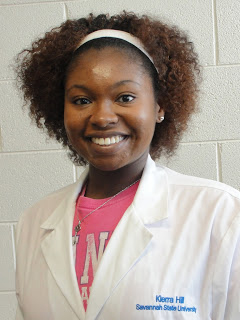
Student Spotlight : Kierra Hill

Kierra Hill
"My name is Kierra Hill, and I am a biology major in the College of Sciences and Technology (COST). I am a recipient of the MAGEC-STEM PLUS Scholarship, and I receive financial aid."

"Financial aid is a fundamental part of my matriculation here at Savannah State. Without the combination of my scholarship and financial aid, I would not be able to fund my education, and ultimately, attain my dream of becoming a neurologist. I am grateful for the opportunities afforded to me by my scholarship, as well as financial aid."

Through the MAGEC-STEM PLUS program, Kierra has been able to conduct research in the field of chemistry overseas in one of the most prestigious universities in China; Tianjin University, in Tianjin, China. She is a firm believer that aid in any form, whether it be in the form of a scholarship or financial aid, is very important in the success of a student determined to reach his or her goal of graduating.

Monday, June 8, 2015

Student Spotlight : Enow Ayuk

Enow Ayuk
Enow came to Savannah State University to pursue his goal of becoming a neurosurgeon.

Enow's grandfather - his inspiration - was an enthusiastic advocate of Enow's studies. He began showing signs of Alzheimer's, and after he passed in 2013, Enow was faced with an unsure academic future.

Before coming to Savannah State, Enow sat out for two semesters, unable to raise enough in financial aid to return to school.

In those months, he rededicated himself to his passion for science and decided he would work towards finding a cure for Alzheimer's once he returned to school.

Aware of the challenges ahead, he studied during the summer to be sure he was ready for fall. Enow became a Peach State Louis Stokes Alliance for Minority Participations (PSLSAMP) scholar and accepted Hope, research, and presidential scholarships.

It wasn't easy at first, but he realized that the opportunities are endless here at SSU.

This summer, Enow will study antibiotic-resistant bacteria through a research program at Alabama State.

And he knows that with determination and drive, anything is possible.

Tuesday, December 2, 2014

SSU Professor Exhibits Paintings

Karla-Sue C. Marriott, professor and coordinator of forensic science and chemistry at Savannah State University will exhibit her latest paintings January 19 - February 20, Monday through Friday, 10 a.m. - 5:00 p.m. in the gallery located in the Social Sciences Building. An opening reception will be held on Friday, January 20th at 6:00 p.m.

The exhibit, entitled Dancing with Nature: Being Human, focuses on naturalistic works that include selections and treatment of subject matter from nature.

Dr. Marriott states:
“I started out dabbling just for fun. I needed something different to do outside of my profession as a chemist. If anything is to be fun, there has to be freedom, no limitations, and no time constraints. So, in January 2010, I decided to try painting with acrylic on canvas. I did not know what to paint and I didn’t know how to paint. So, I decided I would try abstract. Abstract eventually evolved into me painting images that represented feelings. In October 2013, I challenged myself with portraits. My very first portrait, titled “Hemingway” was a blissful experience, during which I painted energized all night long until morning for four days straight while on fall break. With that experience, I knew there was no turning back. In January 2014, I stepped out into my backyard, I looked up, and I saw images formed by the clouds. I fell in love. That initiated my first piece inspired by nature titled “Heavenly Love.""