SAVANNAH – Savannah State University’s (SSU) Christopher Hintz, Ph.D., professor of marine sciences, led a team of volunteers with the Tybee Sea Turtle Project this summer.
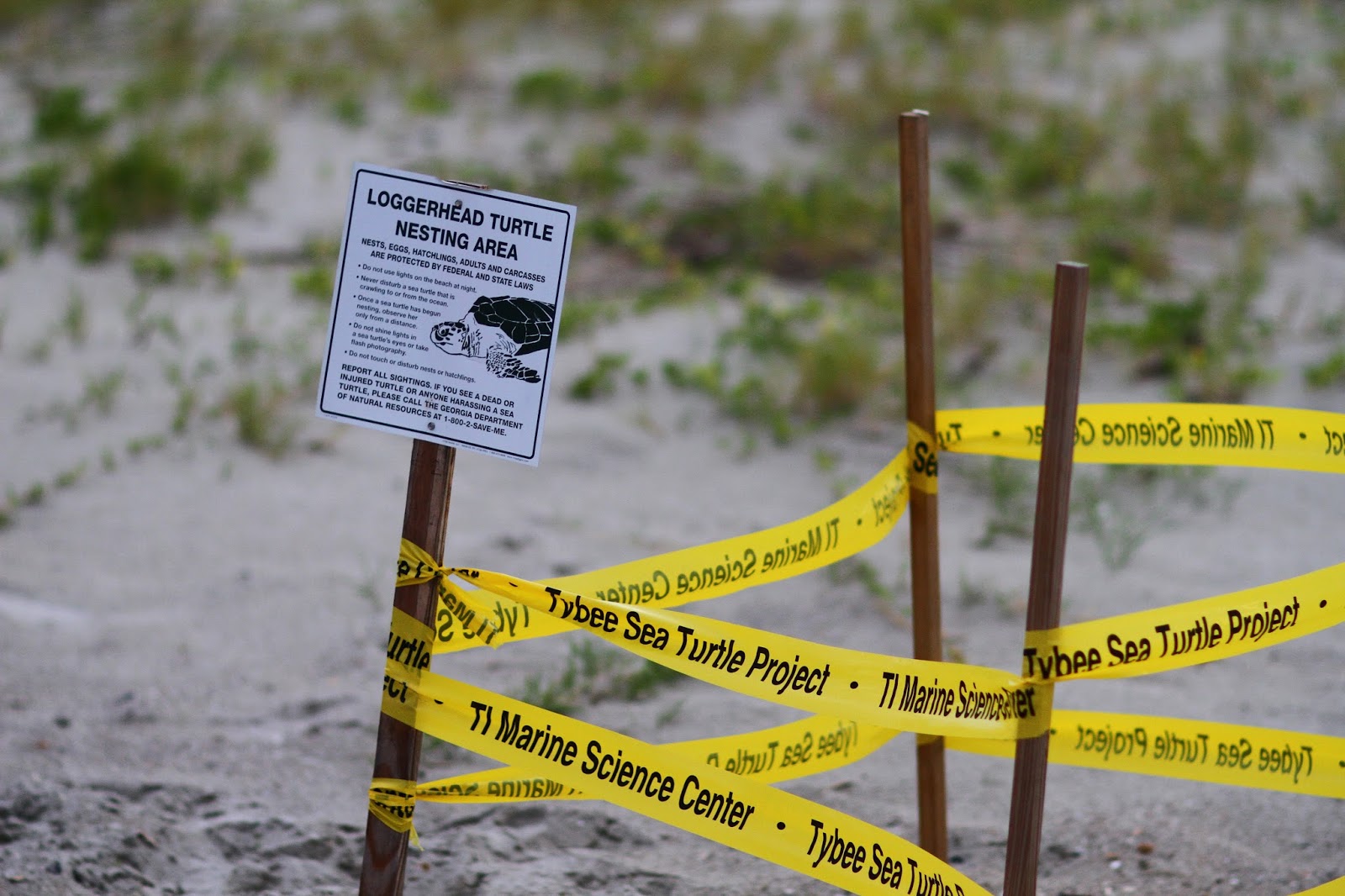
The Tybee Sea Turtle Project is a volunteer organization permitted by the Georgia Department of Natural Resources (DNR) to monitor and assist nesting sea turtles on Tybee, a developed barrier island. Every day in the summer, volunteers walk the three-mile long beach looking for turtle crawls, evidence of a sea turtle nest.
At the end of the incubation period, the volunteers sit by the nests, particularly in highly impacted areas of Tybee Island, to ensure the hatching turtles are oriented properly and make it to the ocean. Hintz participates regularly in the project’s activities and outreach opportunities. The volunteers have assisted in the release of more than 40 hatchling sea turtles that had not emerged by day five and were at risk of perishing in the nest.
Nationwide, sea turtle nests are at a record high for the 2016 season, including record numbers in the states of Georgia, Florida and South Carolina. The hatching period runs from May 1 – October 31. The best way citizens can protect sea turtles is to reduce artificial lights (e.g., flashlights or cell phones) on the beach at night, and turn off any lights on beachfront properties as soon as it is dark.
Established in 1890, Savannah State University is the oldest public historically black college or university in Georgia and the oldest institution of higher learning in the city of Savannah. The university’s 4,800 students select majors from 30 undergraduate and six graduate programs in three colleges — Liberal Arts and Social Sciences, Business Administration and Sciences and Technology — and the School of Teacher Education.
-- SSU --
Showing posts with label marine science. Show all posts
Tuesday, September 6, 2016
SSU professor assists in sea turtle hatching
Labels:
biology,
cost,
environmental science,
hatching,
marine science,
sea turtles,
tybee
Tuesday, May 31, 2016
A Dolphin Tale
A DOLPHIN TALE
This article originally appeared in the 2015 edition of ARISING: The Research Journal of Savannah State University
When a dolphin washed ashore on Tybee Island in early February, it could have been another heart-wrenching tale of an animal meeting a tragic end. But thanks to Savannah State University’s Marine Mammal Program, the death of the bottlenose dolphin known as Phineas will become a teachable moment.
Led by Tara Cox, Ph.D., an associate professor of marine sciences, the Savannah State Marine Mammal Program had been tracking Phineas since 2009. The program is funded through several grants at the university, including the Title VII, National Science Foundation Enhancing Diversity in Geoscience Education (EDGE), Bridge to Research in Marine Sciences Research for Undergraduates (REU) and Students Engaged in Naval STEM Research (SENSR) programs, among others.
Eleven undergraduate and three graduate students from the various grant programs currently serve as interns in the Marine Mammal Program. The students assist faculty with tracking the local dolphin population in Savannah-area waterways, then map their results back in the SSU Dolphin Sciences Lab.
The SSU Marine Mammal team had spotted Phineas at least 16 times over the past five years, tracking the adventurous mammal as he swam around Tybee Island and up and down the Bull River. Beachgoers found Phineas’ body on Tybee’s north beach and contacted local authorities. The Georgia Department of Natural Resources was called in and performed the necropsy with assistance from SSU students and staff. The DNR then shared the deceased dolphin’s picture to its local stranding network, of which Savannah State is a part.
“When they did the necropsy, the dorsal fin was in really good shape,” explains Cox. “We identify animals by unique patterns of nicks and notches on their dorsal fins. My lab manager Robin Perrtree immediately recognized that it was one of our animals.”
Cox hopes that the lab results from Phineas’ necropsy will shed some light on why the dolphin was so emaciated and sickly when he washed ashore. The samples taken during the necropsy are currently being tested for a variety of illnesses including brucellosis, a bacterial infection, and morbillivirus, an illness similar to the human form of measles.
While disease may have been the cause of Phineas’ death, other dolphins in the area face challenges brought on by humans. Through their research, Cox and her team have discovered that the Savannah area has the world’s worst begging problem.
“We see dolphins begging about two-thirds of our days on the water and about a quarter of our sightings,” explains Cox, who developed five metrics to compare dolphins in the Savannah area to those in other dolphin hotspots around the world.
Begging poses a danger to dolphins, which are at risk for injury when they swim so closely to boats. The human snacks that boaters often feed dolphins can also harm the popular mammals.
Cassandra Harris, a sophomore marine sciences major from Stone Mountain, Ga., is currently working in the Marine Mammal Program to reassess human interaction with the local bottlenose dolphin population, updating research that was conducted by Perrtree over the last several years. Harris, who has been intrigued by dolphins since she visited Sea World as a child, is chronicling the number of begging events per sighting and per day, as well as the number of human interactions per sighting and per day.
Harris’ research will help Cox and her team understand the extent of dolphin-human interaction in the area. “My ultimate goal is to affect policy with our science,” says Cox, explaining that members of the National Oceanic and Atmospheric Administration (NOAA) came to Savannah a few years ago to observe the waterways and conduct outreach. Cox and her team also regularly visit schools and talk to local fishermen in hopes of discouraging people from feeding dolphins.
“It looks like there has been a slow decline [in begging],” Cox says. “It’s hard to say why, but we’re getting news articles out, we’re doing outreach and there’s been some enforcement. That may be making a difference.”
Harris’ research will be presented at a conference this spring and will be an important step in addressing and understanding the issues facing the local population, something that will help protect dolphins like Phineas for years to come.
This article originally appeared in the 2015 edition of ARISING: The Research Journal of Savannah State University
When a dolphin washed ashore on Tybee Island in early February, it could have been another heart-wrenching tale of an animal meeting a tragic end. But thanks to Savannah State University’s Marine Mammal Program, the death of the bottlenose dolphin known as Phineas will become a teachable moment.
Led by Tara Cox, Ph.D., an associate professor of marine sciences, the Savannah State Marine Mammal Program had been tracking Phineas since 2009. The program is funded through several grants at the university, including the Title VII, National Science Foundation Enhancing Diversity in Geoscience Education (EDGE), Bridge to Research in Marine Sciences Research for Undergraduates (REU) and Students Engaged in Naval STEM Research (SENSR) programs, among others.
Eleven undergraduate and three graduate students from the various grant programs currently serve as interns in the Marine Mammal Program. The students assist faculty with tracking the local dolphin population in Savannah-area waterways, then map their results back in the SSU Dolphin Sciences Lab.
Student interns in SSU’s Marine Mammal Program spend time on the water and in the lab. (Clockwise from top) Cody Rigney, a junior marine sciences major, studies distribution of dolphins. Associate Professor of Marine Sciences Tara Cox, Ph.D., is director of the Marine Mammal Program. Rachael Randall, a graduate student in marine sciences, spends time in the lab analyzing dolphin blubber for stable isotope ratios. Cassandra Harris, a sophomore marine sciences major, is working to reassess human interaction rates of bottlenose dolphins.
The SSU Marine Mammal team had spotted Phineas at least 16 times over the past five years, tracking the adventurous mammal as he swam around Tybee Island and up and down the Bull River. Beachgoers found Phineas’ body on Tybee’s north beach and contacted local authorities. The Georgia Department of Natural Resources was called in and performed the necropsy with assistance from SSU students and staff. The DNR then shared the deceased dolphin’s picture to its local stranding network, of which Savannah State is a part.
“When they did the necropsy, the dorsal fin was in really good shape,” explains Cox. “We identify animals by unique patterns of nicks and notches on their dorsal fins. My lab manager Robin Perrtree immediately recognized that it was one of our animals.”
Cox hopes that the lab results from Phineas’ necropsy will shed some light on why the dolphin was so emaciated and sickly when he washed ashore. The samples taken during the necropsy are currently being tested for a variety of illnesses including brucellosis, a bacterial infection, and morbillivirus, an illness similar to the human form of measles.
While disease may have been the cause of Phineas’ death, other dolphins in the area face challenges brought on by humans. Through their research, Cox and her team have discovered that the Savannah area has the world’s worst begging problem.
“We see dolphins begging about two-thirds of our days on the water and about a quarter of our sightings,” explains Cox, who developed five metrics to compare dolphins in the Savannah area to those in other dolphin hotspots around the world.
Begging poses a danger to dolphins, which are at risk for injury when they swim so closely to boats. The human snacks that boaters often feed dolphins can also harm the popular mammals.
Cassandra Harris, a sophomore marine sciences major from Stone Mountain, Ga., is currently working in the Marine Mammal Program to reassess human interaction with the local bottlenose dolphin population, updating research that was conducted by Perrtree over the last several years. Harris, who has been intrigued by dolphins since she visited Sea World as a child, is chronicling the number of begging events per sighting and per day, as well as the number of human interactions per sighting and per day.
Harris’ research will help Cox and her team understand the extent of dolphin-human interaction in the area. “My ultimate goal is to affect policy with our science,” says Cox, explaining that members of the National Oceanic and Atmospheric Administration (NOAA) came to Savannah a few years ago to observe the waterways and conduct outreach. Cox and her team also regularly visit schools and talk to local fishermen in hopes of discouraging people from feeding dolphins.
“It looks like there has been a slow decline [in begging],” Cox says. “It’s hard to say why, but we’re getting news articles out, we’re doing outreach and there’s been some enforcement. That may be making a difference.”
Harris’ research will be presented at a conference this spring and will be an important step in addressing and understanding the issues facing the local population, something that will help protect dolphins like Phineas for years to come.
Labels:
arising,
biology,
bottlenose dolphin,
cost,
marine mammal,
marine science,
savannah,
savannah state,
water
Friday, January 29, 2016
Harris Neck: Returning a land to its people
“Harris Neck: Returning a Land to Its People” originally appeared in the fall 2015 edition of Impressions, the Official Magazine of Savannah State University.
Story and photography by Meaghan Walsh Gerard.
In October of 2014, Savannah State University’s Otis Johnson, Ph.D., scholar-in-residence, Dionne Hoskins, Ph.D., professor of marine sciences and director of National Oceanic and Atmospheric Administration (NOAA) sponsored programs, and Jolvan Morris, Ph.D., Living Marine Resources Cooperative Science Center (LMRCSC) postdoctoral fellow, presented “Coastal Citizens: Where Ecology, Culture, and Politics Intersect” as part of the Distinguished Lecture series in the Asa H. Gordon Library. The lecture focused on the ecology of the southeastern seaboard, especially barrier islands and marshlands, with a number of Harris Neck Land Trust members in attendance. Those land trust members have been fighting to return to the acreage that is now a U.S. National Wildlife Refuge. Hoskins and Morris have been gathering oral histories from the Harris Neck residents and descendants.
“The African American Fisherman Oral History project is an ongoing initiative, so we are in fact continuing to collect oral histories from Harris Neck and several other Gullah Geechee communities from North Carolina down to Florida,” Morris says. “The oral history project explores the role and importance of fishing in these unique communities.”
The History
The Georgia barrier islands have been inhabited since early natives fished and hunted there. It was permanently settled in the 1750s by the Demetre-Harris family as a Sea Island cotton plantation. Following the end of the Civil War, owner Margaret Ann Harris willed the estate to her freed slaves. Many remained at Harris Neck and established a small fishing community. The small village’s micro-economy prospered and practiced sustainable farming and fishing techniques.
So they had a season and worked within that environment and they preserved the environment. Now everything had to work in connection with each other for you to get the maximum benefits from the environment. I don’t really think that they know that they were environmentalists, but they were good at it. - Wilson Moran, resident
In 1942, the U.S. Government was looking to acquire property up and down the coast for military use. Eminent domain claimed hundreds of acres of strategic land for use toward the war effort. Harris Neck was one of those places. A small airbase housed P-39s and P-40s to scout the Atlantic for possible German submarines throughout the war.
In 1944, the Federal Surplus Act was passed, which released the properties condemned in 1942. In 1948, Harris Neck was transferred to McIntosh County, which accepted a provisional deed to keep the airstrip in working order for the benefit of the county and surrounding areas rather than transferring it back to the former residents, as they claim to have been promised.
From 1948 to 1961, Harris Neck became a den of iniquity. The tarmac became a drag strip. The old officer’s club held illicit parties. The county commissioner illegally grazed his cattle. Meanwhile, former residents and their descendants had forged new lives outside of the fishing and aquaculture community.
When the federal government finally caught up to the county’s misdeeds, it reclaimed the land in 1962, stating McIntosh County was in violation of the terms of the airport requirements. It reverted to Fish and Wildlife Services (FWS) and became a National Wildlife Refuge, primarily on the basis of a bird called the wood stork.
And my mother used to go down there on low tide, when it was time for the oyster season; she would go down there … and she’d open oysters, bring back and fix for us to eat, and then she would take the little dip net when the tide coming back in … and see the crabs comin’, and she’d put it out there and catch them and put it in the bucket. ... Yeah. Harris Neck was a blessed place.- Olive Smith, resident
Former residents and descendants of those who lived on the small barrier island formally established the Harris Neck Land Trust in 2006, but they had been challenging the federal decision since it was made in the 1960s. Congressional legislation never made it out of committee for a vote. In 1980, a small group sued the government in Edgar Timmons, Jr. v. United States of America.
Our community plan will protect and preserve the wildlife, land and waters of Harris Neck. It sets aside, for permanent protection, all the ponds created by FWS and puts a buffer zone around Woody Pond, the main bird nesting pond, that is twice the setback distance recommended by the scientific studies. - David M. Kelly, project coordinator, Harris Neck Land Trust, U.S. Congress subcommittee hearing, December 2011.
Today the Harris Neck Land Trust continues to lobby for the ability to return. They held a symposium on the campus of Savannah State in February 2014. The conference explored the history of Harris Neck since 1863 and the environmental justice movement in Harris Neck since 1942.
A Teaching Moment
In 2014, the wood stork was down-listed from endangered to threatened, due in large part to the protected rookeries at Harris Neck Wildlife Refuge. It is one of a string of coastal marshes and forests protected for migratory birds and other wildlife. Tara Cox, Ph.D., professor of marine sciences, gave her students real-world experience. She asked them to create a plan that accounted for the Harris Neck Land Trust’s requests as well as the concerns of U.S. Fish and Wildlife.
“Students are encouraged to choose group projects that have actual applications in coastal zone management (CZM) class,” Cox says. “As I was investigating ideas for group projects for fall 2014, I was working with my Conservation Biology class on the Harris Neck project. The site plan seemed like the perfect fit for the CZM class — they needed to understand and incorporate all aspects of coastal zone management into the plan and it could benefit multiple parties — the Harris Neck Land Trust and the U.S. Fish and Wildlife Service.”
Coral Thompson, master of science in marine sciences candidate in Cox’s class, recalls the difficulty in balancing the two objectives. “My focus throughout undergraduate school was biology and I never thought about the politics involved or the social side of science,” she says. “The curriculum of the CZM class encompassed the laws regarding natural resources, and Dr. Cox encouraged the class to consider the impact of these laws and restrictions on the people living along the coast.
“This project was both grueling and rewarding,” she continues. “I did a lot of research on the culture of the Harris Neck Land Trust and their ancestors. As a person, the easy solution is to tell the government to simply return the land that was wrongfully taken. But the laws regarding wildlife refuges do not allow for the answer to be so simple. … In the end, our group wrote out a possible agreement for the two involved parties where only a small portion of the land would be leased to the land trust and the refuge would be gaining volunteers.”
The class’s carefully crafted plan was submitted to the Department of the Interior for consideration. It included a site map, accounting for refuge areas, a small number of environmentally sustainable houses, a working oyster factory and a heritage center. The proposal was recently rejected by the Department of the Interior. The Harris Neck Land Trust is working on future plans but they are not yet releasing the details.
They are determined to find a way to live in harmony with the land once again.
Further reading: Voices from the Fisheries – NOAA Oral History project
View more photos from Harris Neck Wildlife Refuge
Thursday, October 29, 2015
Savannah State students release oceanography trackers

© 2015 SSU Marine Sciences
SAVANNAH – Students in the new graduate Advanced Oceanographic Instruments and undergraduate Oceanographic Instruments courses deployed two surface current drifters using Savannah State University's (SSU) research vessel Margaret C. Robinson on Friday, October 16.
In classes leading up to the deployment both the undergraduate and graduate students built the biodegradable drifters from bamboo and canvas. The graduate students devised the experiment to deploy in the historic floodwaters flowing out of the Edisto River, South Carolina, and into the coastal ocean.
“This real-life experience in experimental development, instrumental design and construction is key for our students to gain while at SSU so they can apply this knowledge out in the workforce or graduate school after graduation,” says Christopher Hintz, Ph.D., associate professor in marine and environmental sciences.
The positions are captured by GPS and the data is sent by satellite to ground based data storage approximately every 6 hours. The drifters are designed to stay afloat for several months. Rachael Randall, a graduate student in the marines sciences program, says, “One of the coolest things about this project was resurrecting skills we thought we would never use working in marine science, like sewing, and actually making an instrument that is reliable enough to support a really expensive satellite transmitter.”

The class took the drifters out in the early morning hours and had calm seas. “The deployment of the drifters was an exciting experience,” says student Nick Castellane. “A good amount of effort went into making these, and knowing the information received will contribute to the scientific community the world over is beyond gratifying.”
Though the drifters only report their positions, the information can be combined with data from the Integrated Ocean Observing System (IOOS). SSU’s classes are also using salinity and wind data from the Fripp Island NOAA Buoy to correlate the floodwater current movements with other factors in the area. “This is a real-world example of how oceanographers can use the multitude of oceanographic instruments and data available to understand regional to global scale processes,” Hintz adds.
Track the drifters.
Established in 1890, Savannah State University is the oldest public historically black college or university in Georgia and the oldest institution of higher learning in the city of Savannah. The university’s 4,900 students select majors from 27 undergraduate and five graduate programs in three colleges — Liberal Arts and Social Sciences, Business Administration and Sciences and Technology — and the School of Teacher Education.
Media Inquiries: email Loretta Heyward at heywardl@savannahstate.edu or call her at: (912) 358-3049.
-- SSU --
Labels:
cost,
drifters,
marine science,
oceanography,
research,
savannah,
savannah state
Friday, January 2, 2015
Federal Research Permits Granted
Assistant Professor Tara Cox in marine sciences has been granted continuing permits for the study of bottlenose dolphins. The federal permits are required to carry out research that results in interaction with marine mammals.
These renewals allow professors and students to:
to conduct close approach, photo-identification, behavioral observations, passive acoustics, and focal follows of coastal and offshore bottlenose dolphins, Atlantic and pantropical spotted dolphins, short-finned pilot whales, beaked whales, and Risso's dolphins in estuarine and coastal waters of Georgia and South Carolina. The study is designed to continue research on dolphin-human interactions related to coastal fisheries, foraging ecology, and social structure of the local bottlenose dolphins.Read the entire notice from the National Oceanic and Atmospheric Administration (NOAA) and SSU's marine science research project here.
Labels:
bottlenose dolphin,
cost,
federal permit,
highlight,
marine mammal,
marine science,
noaa,
research
Wednesday, November 12, 2014
SSU Attends National NOAA Conference
The National Oceanic and Atmospheric Administration (NOAA) Educational Partnership Program (EPP) held its seventh Biennial Education and Science Forum on October 26-29, 2014. Savannah State University (SSU) was represented by a group of ten members, led by Dr. Dionne Hoskins, director of NOAA-sponsored programs. The delegation included two undergraduate students (Darius Stanford and Shaneese Mackey), six graduate students (Keya Jackson, Emma Schultz, Chelsea Parrish, Jennifer Gϋt, Tiffany Ward, and Sanya Compton), and one postdoctoral fellow (Dr. Jolvan Morris).
Subscribe to:
Posts (Atom)


